Read the Signs.


When we think about African cities, we are presented with a monolithic expression of what could be the modern African city. Quayson (2014) and Simone (2004) challenge the way in which we begin to understand African cities and illustrate the dynamism and the intricate relationships that create African streets that provide life, character and uniqueness to it’s city.
The image above is of a “matatu”, a form of public transport that is popular in Kenya. I took this image in the city of Mombasa, Kenya’s second largest city after Nairobi. Matatus are known to have elaborate designs on their exterior, from spray-painted images of African American rappers to prophetic inscriptions that often go from religious (God Above All) to more abstract societal commentary (Just Don’t Cheat This Time). Similarly to Quayson’s (2014) analysis of mobile inscriptions in Accra, the inscription above provides insight into the religious testimonies of the owner of the vehicle. Further to this, the religious inscription closely placed with the social commentary that may suggest infidelity, reflects humanity in it’s simplest form where we see faith and redemption amidst the chaos of the city. What such imagery brings to the forefront is the intricacy of the African experience and expression, how these are interconnected with the realms of both cultural and religious life but also reflecting the silent influences of urban creativity.
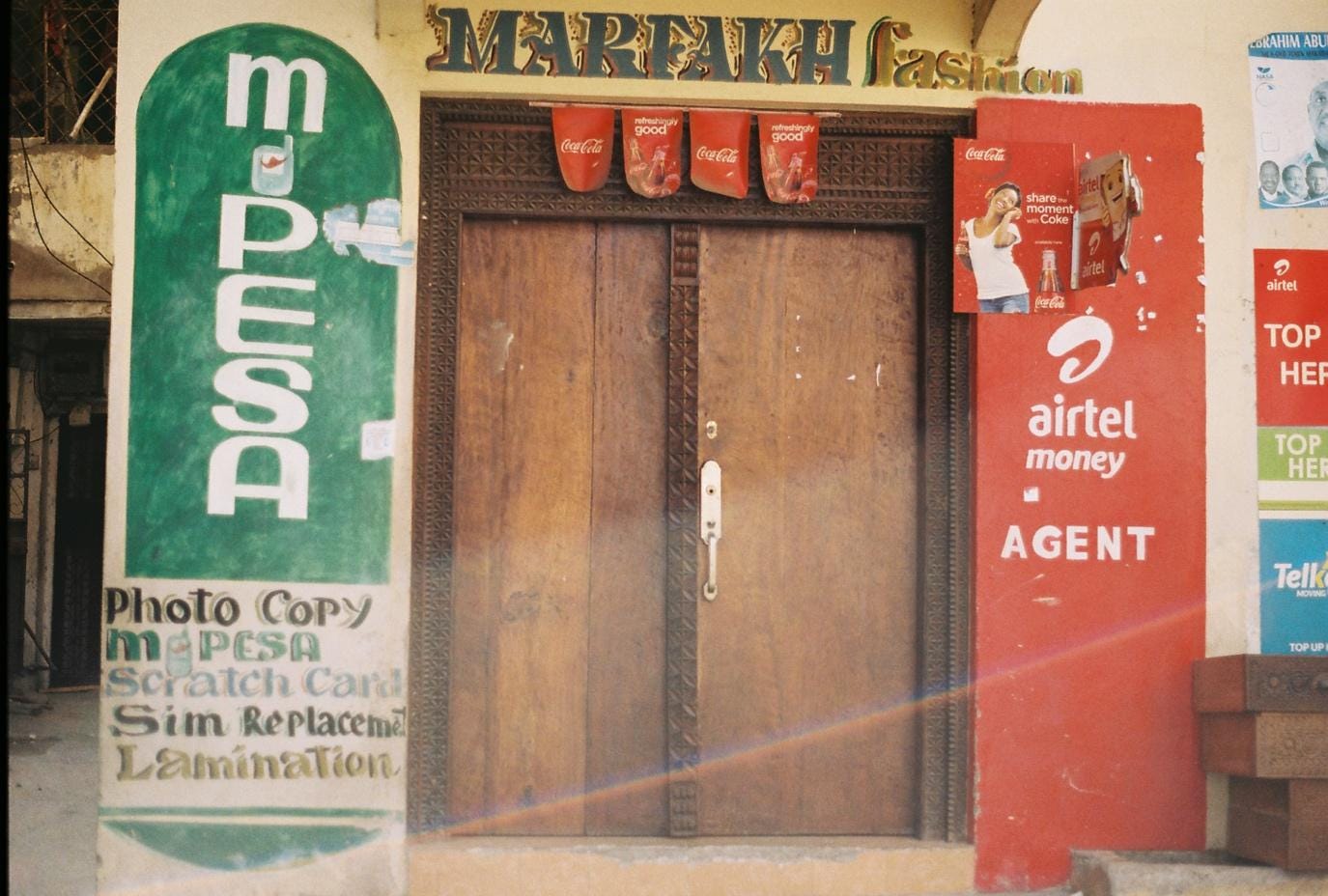
The image below was taken in Mombasa’s CBD and shows the outside of a shop. Upon taking this image, what initially captured me was the fine details of the door which would suggest that it is an old Lamu door, with the style first developed along the Kenyan coast in the early 1800s. Upon closer inspection, Simone (2004) comes to mind. The ways in which infrastructure has been understood often sits within a western urban imaginary where aspects of urban life are often deemed as invisible. The image represents the way African cities have had to change, develop and refocus where numerous elements of urban life have had to make themselves visible in the open streets. The shop is a fashion store, a money transfer hub, a SIM card and airtime top-up stop and lastly, a photocopy and lamination centre. The shop represents the notion that not everything within the African city is what meets the eye and within the confines of this infrastructure is a complex network of actors and flows, where exchanges are made which may not be visible but are the foundations of the contemporary African city.